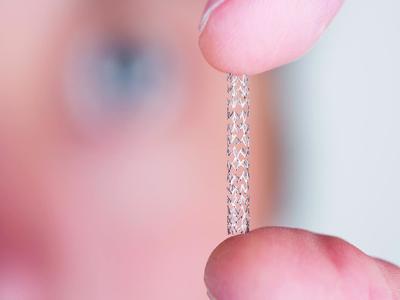
The proposed device is a self-expanding, drug-eluting metallic stent manufactured via 3D additive printing (Selective Laser Melting) using a superelastic Nitinol (Nickel-Titanium) shape-memory alloy.
- Device Technology & Intended Use: The stent features a 3D-printed auxetic (negative Poisson's ratio) geometry optimized for the coronary arteries. It is designed for the transcatheter treatment of de novo stenotic lesions caused by atherosclerosis. It is delivered in a compressed state and self-expands upon release from a retractable sheath when exposed to body temperature.
- Intended Clinical Benefits: The device permanently restores coronary blood flow by exerting a continuous outward radial force against the arterial wall. The auxetic geometry ensures zero longitudinal foreshortening during deployment, allowing for highly accurate placement across the cardiac lesion. A biomimetic, laser-induced superhydrophobic surface texture repels blood proteins to prevent acute thrombosis. Simultaneously, a bioresorbable polymer coating elutes Sirolimus to inhibit smooth muscle cell hyperproliferation, preventing long-term in-stent restenosis.
- Intended Users: Board-certified interventional cardiologists operating in a clinical catheterization laboratory equipped with fluoroscopy.
- Limitations: The device is highly dependent on ultra-precise 3D-printing resolutions (70–100 µm struts) to ensure strut clearance during maximum compression. It also requires strict thermal control during shipping and storage to maintain the Nitinol in its compressed (Martensitic) phase prior to surgery.
- Contraindications: The device is contraindicated for patients with known hypersensitivities to Nickel or Sirolimus, patients unable to tolerate long-term dual antiplatelet therapy (DAPT), and patients with target lesions that cannot be crossed by standard 0.014-inch guidewires or microcatheters.